


27.08.2026
How
Homogenizer: Operating Principle, Pressure, and How to Select the Right Equipment
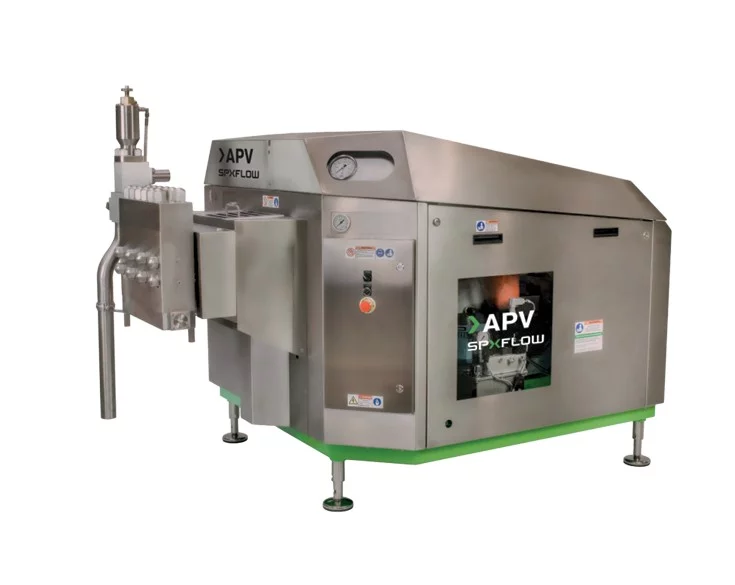
A homogenizer is an important part of processing lines for milk, dairy products, beverages, emulsions, and other food products. The stability, texture, and properties of the final product depend on correctly selected pressure, temperature, and homogenization configuration.
In this article, we will explain how an industrial homogenizer works, the difference between single-stage and two-stage homogenization, what pressure is required for different process applications, and what should be considered when selecting the equipment.
How an Industrial Homogenizer Works
An industrial high-pressure homogenizer essentially combines a high-pressure pump with a homogenizing valve.
The product enters the pumping section, where its pressure is significantly increased. It then passes under high pressure through a very narrow gap in the homogenizing valve.
In this zone, the flow velocity increases sharply while the pressure drops. Intense turbulence, shear forces, and other hydrodynamic effects occur, causing larger droplets or particles to break down and become more evenly distributed throughout the product.
As a result, homogenization can affect:
emulsion stability;
particle size and distribution;
the product’s tendency to separate;
consistency and viscosity;
appearance;
sensory properties;
product stability during storage.
For example, during milk homogenization, the size of fat globules is significantly reduced. This allows the fat to remain more evenly distributed throughout the product and reduces its tendency to cream or separate.
Therefore, a homogenizer should not be viewed simply as a pump that creates high pressure. The main technological effect is generated when the product passes through the homogenizing valve.
Single-Stage and Two-Stage Homogenization
An industrial homogenizer may use either one or two homogenization stages.
Single-Stage Homogenization
In a single-stage configuration, almost the entire required pressure drop is generated across one homogenizing valve.
This solution can be used for products and processes where one stage is sufficient to achieve the required particle size and product stability.
Two-Stage Homogenization
In a two-stage homogenizer, the product passes through a second homogenizing valve after the first stage.
Most of the particle size reduction usually takes place in the first stage. The second stage can be used to control agglomeration and achieve a more stable particle distribution.
It is important to understand that the second-stage pressure is not simply added on top of the first-stage pressure. During equipment setup, the pressure is distributed between the stages depending on the product, the design of the homogenizing valves, and the required technological result.
Therefore, the choice between single-stage and two-stage homogenization should not be based on the assumption that “two stages are always better.” The correct configuration depends on the specific product and the required result.
What Pressure Is Required for Homogenization
Pressure is one of the main operating parameters of a homogenizer, but there is no universal value that works for every product.
Even for the same type of product, the required pressure may vary depending on:
formulation;
fat and total solids content;
temperature;
required particle size;
product stability requirements;
homogenizing valve design;
single-stage or two-stage configuration;
the position of the homogenization step within the process.
For example, the typical total homogenization pressure for pasteurized milk may be approximately 140–180 bar. For UHT milk, higher values of around 200–250 bar may be used.
However, these figures should not be treated as ready-made settings for every dairy process.
Cream, yogurt mixes, dairy beverages, juices, nectars, sauces, and other emulsions have different physical properties and require different operating conditions.
In addition, modern homogenizing valve designs may allow the required result to be achieved at a lower pressure. This can be important in terms of energy consumption and operating costs.
Therefore, the principle “the higher the pressure, the better the homogenization” is incorrect.
The objective is not to create the highest possible pressure, but to achieve the required product properties using optimal process parameters.
How to Select the Right Homogenizer
The selection of an industrial homogenizer should begin not with a specific equipment model, but with the technological task.
1. Product
It is necessary to understand exactly what will pass through the homogenizer: milk, cream, a dairy mix, beverage, juice, emulsion, sauce, or another product.
The product composition, viscosity, fat and solids content, presence of solid particles, and other physical properties are important for equipment selection.
2. Capacity
The homogenizer must provide the required capacity not as an isolated machine, but as part of the overall process line.
For example, if the equipment is integrated into a pasteurization line, the capacities of the homogenizer, heat exchanger, separator, pumps, and other process equipment must be properly matched.
3. Operating Pressure
The pressure at which the product achieves the required characteristics must be determined.
It is important to consider not only the maximum pressure that the homogenizer can generate, but also the actual operating conditions.
The combination of flow rate and pressure largely determines the required equipment power.
4. One or Two Stages
The choice depends on the product, stability requirements, and the required particle distribution.
Two-stage homogenization may be necessary for certain emulsions, but its use should always be technologically justified.
5. Product Temperature
Temperature affects viscosity, the behavior of the fat phase, and overall process efficiency.
For this reason, the product temperature before homogenization should be considered already at the process design stage.
6. CIP Cleaning
In food production, it is important to evaluate not only the operating mode, but also how the equipment will be cleaned.
The homogenizer must be correctly integrated into the CIP circuit. The required cleaning solution flow, sequence of operations, temperature conditions, and correct valve operation during cleaning must all be ensured.
7. Automation
Depending on the production process, the system may require manual or automatic pressure control, temperature monitoring, alarms, data transfer to PLC/SCADA, and integration of the homogenizer into the automation system of the entire line.
8. Integration into the Process
This is one of the most important aspects.
A homogenizer rarely operates as a completely independent piece of equipment. It interacts with heat exchangers, pasteurizers, separators, pumps, valves, buffer tanks, and the CIP system.
Therefore, before selecting a specific model, it is necessary to determine:
where the homogenizer will be installed, what the product parameters will be at the inlet and outlet, and how its operation will affect the other stages of the process.
5 Common Mistakes When Selecting a Homogenizer
1. Selecting Equipment Based Only on Capacity
Two homogenizers with the same capacity may be designed for completely different operating pressures and process requirements.
Therefore, a specification such as “10,000 l/h” by itself provides very little information about whether a particular machine is suitable for the process.
2. Selecting Maximum Pressure with Excessive Margin
A certain safety or performance margin is necessary, but significantly oversizing equipment does not necessarily provide a technological advantage.
Higher operating pressure means greater mechanical load on the equipment and may increase energy consumption and operating costs.
The goal is not the highest possible pressure, but a correctly defined operating mode.
3. Ignoring Product Temperature and Properties
The same homogenizer may produce different results depending on the temperature, viscosity, and composition of the product.
Therefore, copying process parameters from another production line without analyzing the specific product may not deliver the expected result.
4. Considering the Homogenizer Separately from the Process Line
Even correctly selected equipment may operate inefficiently if its position in the process is incorrect or if its operating parameters are not coordinated with other equipment.
This is especially important in lines where the homogenizer works together with a pasteurizer, separator, and standardization system.
In such cases, the entire process flow must be analyzed, not just one machine.
5. Ignoring CIP and Maintenance
A homogenizer operates at high pressure and includes components that are subjected to regular mechanical loads.
When selecting equipment, it is important to consider service availability, valve design, seals, plungers, spare parts, and the possibility of carrying out routine maintenance.
It is equally important to ensure correct CIP cleaning already at the process design stage.
A Homogenizer Is Part of the Process
When selecting a homogenizer, it is not enough to determine the required capacity and find a machine with the corresponding number in its technical specification.
It is necessary to understand the product, the required technological result, homogenization pressure and temperature, the position of the equipment in the process flow, its interaction with the pasteurizer and other equipment, automation requirements, CIP, and future maintenance.
This is why a homogenizer should be selected as part of the technological process, not as a standalone machine.
Need to Select a Homogenizer for a New or Existing Production Line?
Viravix Engineering helps determine the required homogenization parameters, select the appropriate equipment, and correctly integrate it into the production line.
We work with industrial APV homogenizers and evaluate the process as a complete system: from heat transfer, pasteurization, and separation to pumps, valves, CIP, automation, and equipment integration.
Contact Viravix if you need to select, size, or integrate a homogenizer into a new or existing process line.