


30.04.2026
How
Dairy
Study
How to Choose a Bactofuge for Dairy Production: A Practical Guide
Why Pasteurization Does Not Solve All Problems
In dairy production, it often seems that the main safety barrier is pasteurization. It effectively reduces the number of vegetative forms of microorganisms, but it does not eliminate the key risk — bacterial spores, particularly Clostridium and Bacillus, which can withstand standard heat treatment regimes.
These spores are the cause of:
- late blowing in cheese
- reduced shelf life
- unstable fermentation
- defects that appear after production
That is why modern dairy plants are moving away from the approach of “increasing heat treatment” toward the approach of: maximum milk purification BEFORE pasteurization.
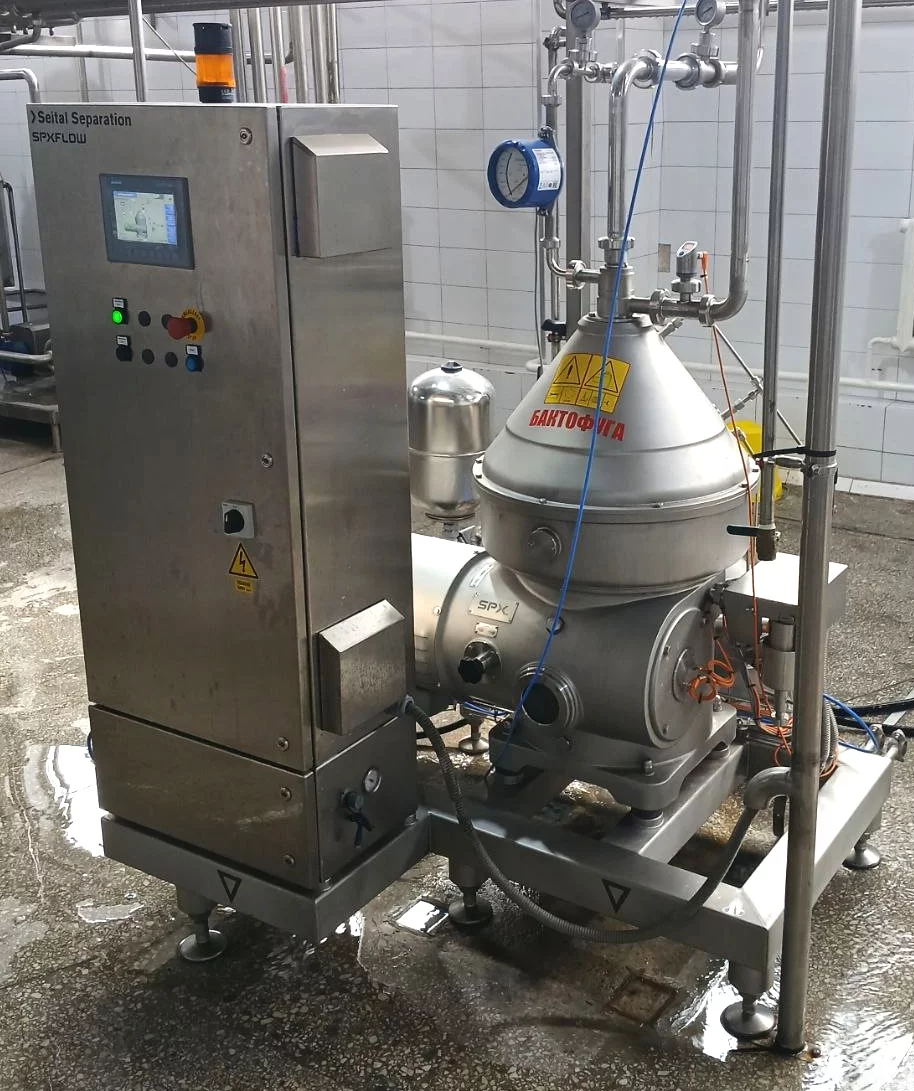
Bactofugation makes it possible to physically remove a significant share of bacteria, spores, and somatic cells at an early stage, forming a stable raw material for further processes.
1. Start Not with the Model, but with the Problem
The first question when choosing a bactofuge is not “what capacity?”, but:
What technological problem needs to be solved?
For different types of production, a bactofuge plays a different role.
| Type of Production | Main Risk | What the Bactofuge Must Ensure |
|---|---|---|
| Cheese | Clostridium spores, late blowing | Maximum spore removal |
| ESL milk | Heat-resistant microflora, shelf life | Reduction of bacterial load |
| Yogurt / kefir | Unstable fermentation | Stable microbiological background |
| Milk powder / ingredients | Raw material quality before concentration | Reduced risk of defects in further processing |
For cheese production, bactofugation is especially important because spore-forming bacteria can cause defects after production — during ripening or product storage.
2. Evaluate the Microbiology of Incoming Milk
A bactofuge should not be selected “based on the market average”. It must be selected according to the actual characteristics of the raw material:
- total bacterial count;
- spore count;
- seasonal fluctuations;
- milk quality from different suppliers;
- share of milk with a high contamination risk.
According to data often used in industry materials, bactofugation efficiency can reach 75–95% for total bacterial count, 97–99% for anaerobic spores, and 85–95% for aerobic spores, depending on process configuration, temperature, and milk quality.
In other words, a bactofuge is not a magical “100% purification” solution, but a tool for significantly reducing risk. Its efficiency depends on a correctly selected technological scheme.
3. Define the Required Capacity with a Safety Margin
A typical mistake is selecting a bactofuge exactly according to the current capacity of the line. In real production, this creates a bottleneck.
It is recommended to consider:
- peak load;
- future expansion;
- line operating mode;
- time required for CIP;
- possible flow fluctuations.
| Processing Capacity | Recommendation |
|---|---|
| Up to 10,000 l/h | Compact solution for a separate line or specialized product |
| 10,000–30,000 l/h | Medium industrial segment |
| 30,000+ l/h | High-capacity solution with a focus on automation, CIP, and loss minimization |
Practical rule: it is better to include a 10–20% capacity margin than to operate at the equipment’s limit.
4. Choose a 1-Phase or 2-Phase System
This is one of the key technical choices.
1-Phase Bactofuge
Suitable when:
- the budget is limited;
- production does not have critical requirements for minimizing losses;
- basic reduction of microbiological load is required.
2-Phase Bactofuge
Recommended when:
- the plant operates with large volumes;
- product loss minimization is important;
- the product has high value;
- better process stability is required.
APV (SPX FLOW) materials specifically emphasize that when removing bacteria and spores, it is important to minimize the volume of retentate / sediment streams, as this directly affects product losses.
5. Calculate Product Losses, Not Just CAPEX
For purchasing departments, equipment price is often the main criterion. But for a bactofuge, a much more important question is:
How much product does the plant lose every day?
Even a 1% difference in losses at large volumes means significant money.
Calculation Example
| Milk Processing Volume | Losses at 2% | Losses at 0.8% | Difference |
|---|---|---|---|
| 50,000 l/day | 1,000 l/day | 400 l/day | 600 l/day |
| 100,000 l/day | 2,000 l/day | 800 l/day | 1,200 l/day |
| 200,000 l/day | 4,000 l/day | 1,600 l/day | 2,400 l/day |
Therefore, choosing a bactofuge is not only a technical decision, but also an economic one. Equipment with a lower CAPEX may turn out to be more expensive in long-term operation due to product losses, longer downtime, or more complex maintenance.
6. Pay Attention to Process Temperature
Temperature affects:
- milk viscosity;
- separation efficiency;
- fat and protein losses;
- process stability;
- energy consumption.
In bactofugation practice, the process often operates in a range of approximately 50–60°C, but the specific mode must be selected according to the product and the line. Research also shows that process temperature can affect casein and fat losses in the sediment, so the regime should not be chosen formally.
7. Check How the Bactofuge Integrates into the Existing Line
A bactofuge does not operate in isolation. It must be properly integrated into the technological scheme:
- after milk reception;
- before pasteurization;
- in combination with a separator;
- in the cheese milk production scheme;
- in the ESL milk line;
- before further concentration or fermentation.
Especially important:
- flow stability;
- inlet pressure;
- synchronization with the pasteurizer;
- CIP capability;
- automatic sediment discharge control.
8. Evaluate Automation and CIP
For a technologist, not only the efficiency stated in the technical passport matters, but also stability during a production shift.
The bactofuge must provide:
- automatic sediment discharge;
- mode control;
- integration with CIP;
- minimization of the human factor;
- stable process repeatability.
If the equipment is difficult to clean or requires frequent operator intervention, this creates a risk not only for productivity, but also for hygiene.
9. Compare the Bactofuge with Microfiltration
Microfiltration can provide a very high level of purification, but it is more expensive, more complex to operate, and more demanding in terms of raw material quality and process regimes. APV (SPX FLOW) also considers microfiltration as a technology for debacterization, fractionation, and clarification in dairy and plant-based applications.
| Criterion | Bactofuge | Microfiltration |
|---|---|---|
| CAPEX | ★★★☆☆ | ★★★★★ |
| Operational Complexity | ★★☆☆☆ | ★★★★☆ |
| CIP Requirements | ★★★☆☆ | ★★★★★ |
| Flexibility for Different Products | ★★★★★ | ★★★☆☆ |
| Bacteria Removal | ★★★★☆ | ★★★★★ |
| Spore Removal | ★★★★☆ | ★★★★★ |
| Payback Speed | ★★★★★ | ★★★☆☆ |
Conclusion: microfiltration makes sense for products with the highest microbiological requirements, but for many dairy plants, a bactofuge provides the optimal balance between efficiency, investment, and ease of operation.
10. Typical Mistakes When Choosing a Bactofuge
Mistake 1. Focusing Only on Price
Low CAPEX does not mean lower total cost of ownership.
Mistake 2. Not Considering Product Losses
Losses with bactofugate can “eat up” the savings already in the first years of operation.
Mistake 3. Selecting Capacity Without a Margin
Equipment operating at its limit quickly becomes a bottleneck.
Mistake 4. Not Analyzing the Raw Material
A bactofuge must be selected according to the real microbiology of milk, not average indicators.
Mistake 5. Ignoring CIP and Service
For dairy production, downtime and hygiene are often more important than passport figures.
11. Why APV (SPX FLOW) Is a Strong Solution for Bactofugation
APV (SPX FLOW) is not just a separate separator or bactofuge, but part of a comprehensive technological logic for dairy production: separation, standardization, heat treatment, membrane processes, CIP, and integration into the line.
Strengths of APV (SPX FLOW):
- deep expertise specifically in the dairy industry;
- solutions for bacterial milk purification and ESL processes;
- possibility of integration with separation, pasteurization, and CIP;
- focus on minimizing product losses;
- technological flexibility for cheese, ESL milk, and fermented products.
Typical Operating Parameters of APV Bactofuges
| Parameter | Value |
|---|---|
| Process temperature | 50–60°C |
| Capacity | 5,000 – 50,000 l/h |
| Bacteria removal | 85–95% |
| Spore removal | 95–99% |
| Product losses | 0.5 – 2% |
| Inlet pressure | 1.5 – 3 bar |
Learn more about APV (SPX) bactofuges
Product Loss Control
| Parameter | Typical Solutions | APV (SPX FLOW) |
|---|---|---|
| Product losses | 2–5% | 0.5–2% |
| Recirculation | partial | full |
| Stability | medium | high |
👉 even a 1% difference means significant losses at production scale
Selection and Implementation
Viravix Engineering helps you go through the entire bactofugation implementation process:
- analysis of technological tasks and raw material
- selection of the optimal APV (SPX FLOW) solution or solutions from other manufacturers
- design of integration into the existing line
- equipment supply
- installation and start-up
- personnel training
- service and technical support
👉 from the initial analysis to stable production operation