


23.07.2026
How
Dairy
Milk Pasteurizer: What to Consider to Avoid Costly Mistakes
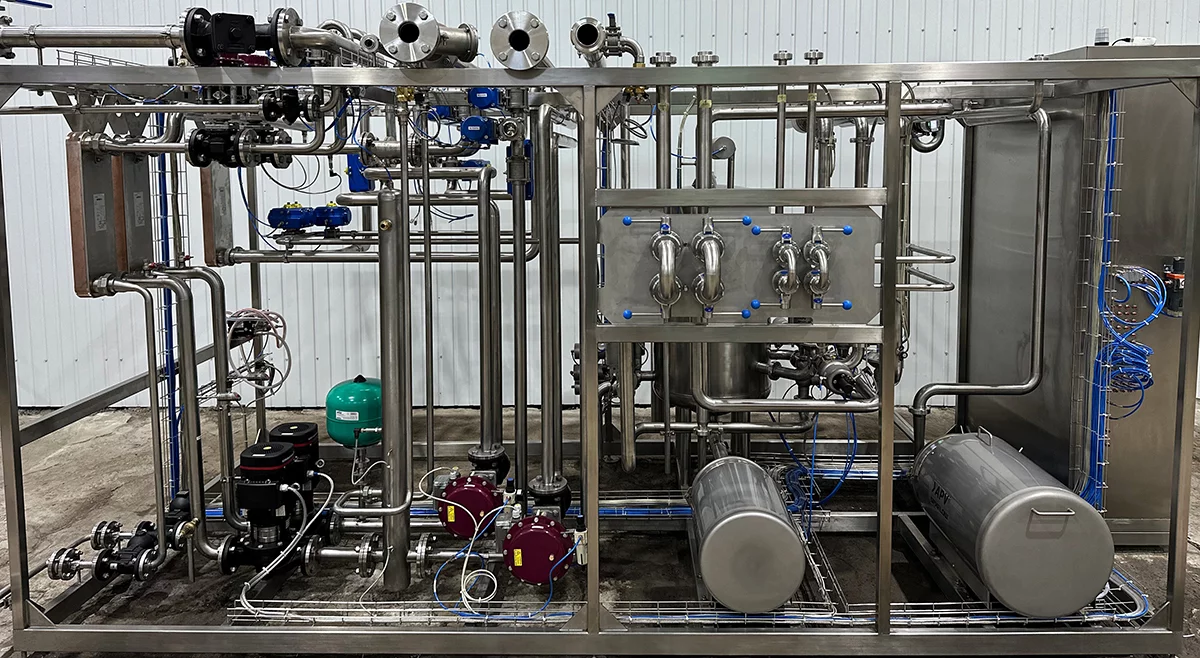
Choosing a milk pasteurizer often starts with two key parameters: capacity and equipment cost. However, these factors alone are not enough to ensure a stable, safe, and cost-effective pasteurization process.
A pasteurizer does not operate as a standalone piece of equipment. It is an integral part of the entire processing line. Its design, automation system, heat exchanger, CIP cleaning capabilities, and integration with other equipment directly affect product quality, operating costs, and overall production reliability.
Let’s take a closer look at the key factors you should consider before selecting a milk pasteurizer.
Why You Shouldn’t Focus Only on the Purchase Price
The initial cost of the equipment is only one part of the total investment your company will make throughout the pasteurizer’s service life.
When comparing different solutions, consider:
steam, hot water, and electricity consumption;
cooling media consumption;
heat recovery efficiency;
water and detergent consumption during CIP cleaning;
maintenance costs;
availability of spare parts;
potential production downtime.
A less expensive pasteurizer may consume significantly more energy, be more difficult to clean, or require more frequent maintenance. Instead of comparing only the purchase price, evaluate the total cost of ownership.
How to Determine the Right Pasteurizer Capacity
Milk pasteurizer capacity is typically expressed in liters per hour. However, simply matching this figure to your current production volume is not enough.
When sizing a pasteurizer, you should consider:
the actual product volume processed per shift;
shift duration;
time required for start-up, shutdown, and CIP cleaning;
number and duration of production cycles;
product range;
future production growth;
plans to introduce new products.
An undersized pasteurizer can quickly become a production bottleneck. On the other hand, excessive capacity increases the equipment cost and may reduce operational efficiency when running at low production volumes.
The optimal solution should meet your current production requirements while providing a reasonable reserve for future expansion.
Why Hygienic Design Matters More Than You Think
A pasteurizer comes into direct contact with a product that is highly sensitive to microbiological contamination. Therefore, hygienic equipment design has a direct impact on milk safety and finished product quality.
Pay particular attention to:
the absence of dead zones and hard-to-clean areas;
complete equipment drainage;
the quality of internal surfaces and welds;
gasket design;
hygienic valves, pumps, and process connections;
elimination of unnecessary dead legs;
the ability to perform fully automatic cleaning without disassembling the equipment.
Connecting a pasteurizer to a CIP system alone does not guarantee effective cleaning. Every section of the product circuit must receive the correct cleaning solution temperature, concentration, cleaning time, and flow velocity.
If the equipment design does not support efficient CIP cleaning, product residues may accumulate inside the heat exchanger, pipelines, valves, or process chambers. This increases the risk of product contamination and reduces the maximum continuous operating time of the production line.
What to Look for When Choosing a Heat Exchanger
The heat exchanger is one of the most critical components of a milk pasteurizer. It is responsible for product preheating, pasteurization, heat recovery, and cooling.
Proper heat exchanger selection directly affects:
temperature accuracy;
uniform product heating;
heat recovery efficiency;
steam and cooling media consumption;
hydraulic pressure losses;
CIP cleaning efficiency;
operating time between cleaning cycles.
Plate heat exchangers are the most common solution for milk pasteurization because they provide excellent heat transfer while recovering a significant portion of the heat from pasteurized milk to preheat incoming raw milk.
However, selecting a heat exchanger involves much more than choosing the required heat transfer area. Product characteristics, temperature profile, allowable pressure drop, fouling tendency, and CIP operating conditions should all be taken into account.
Particular attention should also be paid to protecting the product from internal leakage. Pressure on the pasteurized product side should always remain higher than on the raw milk side or utility side. This helps prevent contamination of pasteurized milk if a plate becomes damaged.
How a Typical Milk Pasteurizer Works
Most modern milk pasteurization systems operate through several sequential stages.
1. Heat Recovery (Regeneration)
Cold raw milk enters the regeneration section of the heat exchanger, where it is preheated using the heat recovered from already pasteurized milk. This significantly reduces steam or hot water consumption.
2. Heating
After regeneration, the milk enters the heating section, where its temperature is raised to the required pasteurization level.
3. Holding
The heated milk flows through a holding tube. Its length and diameter are carefully designed to ensure that the product remains at the required pasteurization temperature for the specified holding time.
4. Temperature Control and Product Diversion
At the outlet of the holding tube, the system continuously monitors product temperature. If the temperature falls below the required setpoint, the flow diversion valve automatically redirects the milk back for reprocessing. Insufficiently pasteurized milk must never proceed to the next production stage.
5. Heat Recovery and Cooling
The pasteurized milk returns to the regeneration section, transferring part of its heat to the incoming raw milk. It is then cooled to the required storage or downstream processing temperature.
In simplified form, the process can be illustrated as follows:
Raw milk → Regeneration → Heating → Holding → Temperature Control → Regeneration → Cooling
If the required temperature is not achieved:
Temperature Control → Flow Diversion → Reheating
The stability of this process depends not only on the heat exchanger itself but also on the accuracy of sensors, the proper operation of valves and pumps, the holding tube design, and the automation control logic.
What Automation Features Really Matter
Automation in a milk pasteurizer is much more than a touchscreen interface and the ability to set the desired temperature.
A complete control system should continuously monitor critical process parameters and automatically respond to any deviations.
Depending on the production requirements, the automation system may provide:
automatic start-up and shutdown of the pasteurizer;
precise temperature control;
holding time control;
flow rate and pressure monitoring;
automatic control of pumps and valves;
automatic diversion of under-pasteurized product;
recipe management;
automatic switching between production and CIP cleaning;
process data recording and archiving;
report generation;
remote diagnostics and service access.
One of the most important safety functions is the flow diversion valve. If the milk fails to reach the required pasteurization temperature, the system must automatically redirect it for reprocessing, preventing under-pasteurized product from entering the next stage of production.
Recording and archiving temperature, flow, pressure, and other process parameters not only helps maintain process control but also provides documented evidence of compliance during internal and external audits.
Why Service Is Just as Important as Equipment Specifications
Even a properly selected pasteurizer requires regular maintenance. Worn gaskets, fouled heat transfer surfaces, faulty sensors, or malfunctioning valves can affect process stability and product quality.
Before purchasing equipment, it is worth clarifying:
who will perform installation, commissioning, and start-up;
whether local technical support is available;
how quickly spare parts can be supplied;
whether operator training is included;
whether remote diagnostics are available;
who services the heat exchanger, pumps, valves, and automation system;
whether the heat exchanger can be tested for leaks and integrity.
Lack of timely service can result in much more than production downtime. Incorrect temperature readings, damaged heat exchanger plates, or improperly operating valves may compromise the safety of the entire production batch.
Why a Pasteurizer Should Be Considered Part of the Entire Processing Line
A milk pasteurizer does not operate independently. It must be properly integrated with the upstream and downstream stages of the production process.
Depending on the application, a complete processing line may include:
receiving and buffer tanks;
filters;
separators;
bactofuges;
milk standardization systems;
homogenizers;
deaerators;
cooling systems;
pasteurized product storage tanks;
CIP systems;
filling and packaging equipment;
centralized automation and monitoring systems.
Poor coordination between individual pieces of equipment can lead to frequent production interruptions, tank overflows, unstable product flow, or equipment operating outside its optimal conditions.
The overall layout of the processing line should also be carefully designed. Pipe routing, pressure balance, valve sequencing, and process control logic all play an essential role in achieving stable and efficient production. A well-engineered system ensures that every component operates as part of one integrated process rather than as separate pieces of equipment.
Choosing a milk pasteurizer should never be based solely on production capacity, purchase price, or a list of components. The true performance of the system depends on how well it matches your product characteristics, process requirements, cleaning strategy, and future production plans. Decisions made during the design stage will directly influence energy consumption, product quality, production efficiency, and the number of unplanned shutdowns for many years.
Viravix designs and delivers complete milk pasteurization solutions tailored to the specific needs of each production facility. We help determine the required capacity, develop the process concept, select heat exchangers and hygienic process equipment, design automation systems, and integrate the pasteurizer with CIP systems and the rest of the production line. We also provide installation, commissioning, operator training, after-sales service, and heat exchanger leak testing to ensure reliable and long-term operation.