


13.08.2026
How
Dairy
Study
Milk Separator: How to Calculate Efficiency and Fat Losses
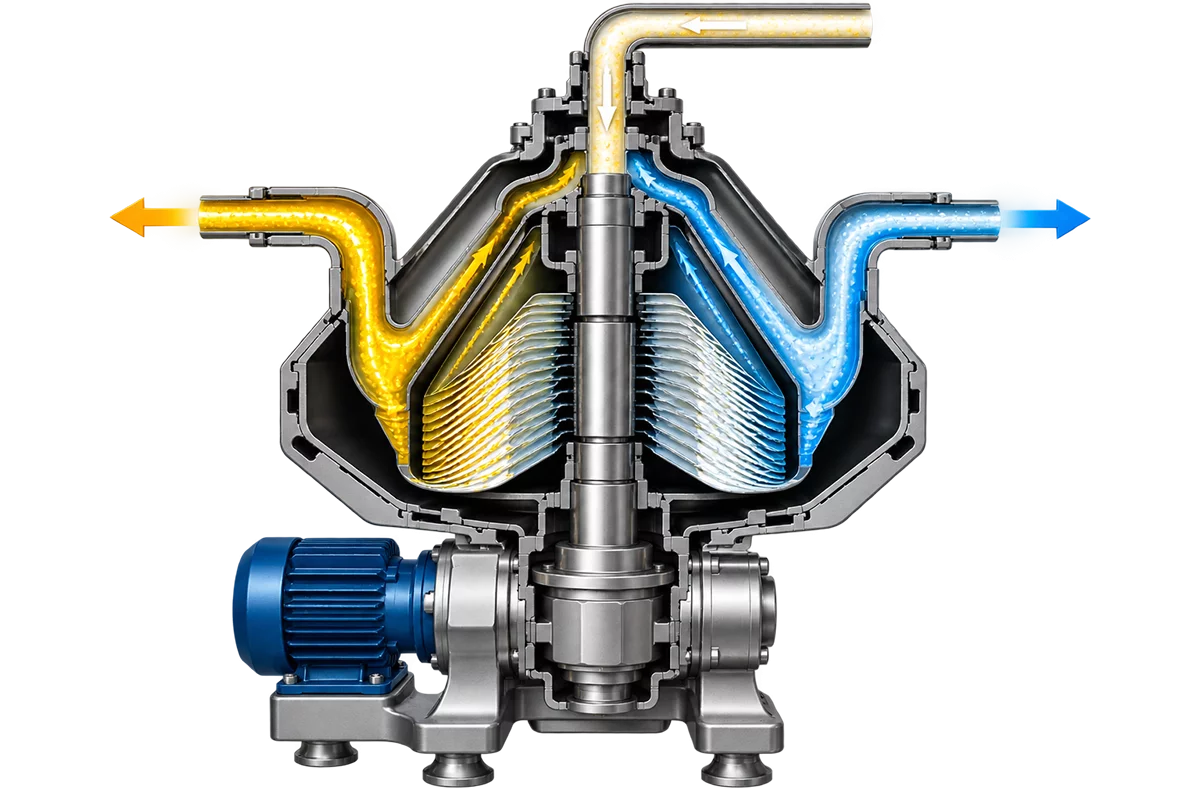
The capacity of a milk separator, expressed in litres or kilograms per hour, is not the only indicator of its performance. For a dairy plant, it is equally important to understand how much fat remains in the skim milk after separation.
At first glance, the difference between 0.05% and 0.09% fat in skim milk may seem insignificant. However, when processing tens or hundreds of tonnes of milk per day, even a few hundredths of a percentage point can translate into kilograms of fat that remain in the skim milk instead of being recovered in the cream.
In this article, we explain what affects milk separation efficiency, how to evaluate it in a dairy plant, and how to convert elevated residual fat in skim milk into real production and economic losses.
What Does Milk Separation Efficiency Mean?
During separation, whole milk is divided into two main streams:
whole milk → cream + skim milk
Fat globules have a lower density than the milk plasma. In the centrifugal field inside the separator bowl, they move toward the axis of rotation and are discharged with the cream, while the skim milk moves in the opposite direction.
In practice, it is impossible to remove all fat completely. The smallest fat globules may leave the separator together with the skim milk.
That is why one of the key practical indicators of separator performance is the residual fat content in skim milk.
In industrial milk separation, a typical residual fat level in skim milk may be around 0.04–0.07%. The smallest fat globules, especially those below approximately 1 µm, are more difficult to separate and may remain in the skim phase.
However, the 0.04–0.07% range should not be treated as a universal standard for every separator and every process. The actual result depends on the separator design, product properties, and operating conditions.
What Affects the Efficiency of a Milk Separator?
Separation performance depends on several parameters. Even a correctly selected and technically sound separator may produce different residual fat values in skim milk when process conditions change.
| Parameter | Effect on the process |
|---|---|
| Milk temperature | Affects viscosity and the movement of fat globules |
| Separator capacity | Higher flow reduces the time available for separation |
| Fat globule size | Smaller globules are more difficult to separate |
| Inlet milk fat content | Affects the mass balance of the product streams |
| Cream fat content | Related to the amount of product discharged through the cream outlet |
| Air and gas in the milk | Can affect process stability and measurement accuracy |
| Condition of the bowl and disc stack | Fouling or incorrect assembly can reduce separation efficiency |
| Process stability | Fluctuations in temperature, flow, and pressure can affect the result |
Capacity
One of the most important parameters is the actual milk flow through the separator.
When the flow rate is reduced, the velocity of the product between the separator discs also decreases. Fat globules have more time to move toward the disc surface and enter the cream phase.
Therefore, under otherwise identical conditions, reducing the throughput may improve fat separation efficiency, while increasing the flow may reduce it.
This leads to an important practical conclusion:
the fact that a separator can physically process a certain amount of milk per hour does not mean that it will achieve the required residual fat content in skim milk at that flow rate.
Separation Temperature
For warm separation, the milk is preheated before entering the separator. In industrial processes, temperatures of approximately 55–65°C are often used, although the exact operating range depends on the product, process design, and separator model.
Cold milk separation is also possible and may be carried out at around 10°C or below. Because cold milk has a higher viscosity, the allowable separator capacity under these conditions is usually lower.
For this reason, residual fat in skim milk should not be analysed on its own. It should always be evaluated together with the separation temperature and actual product flow.
How to Evaluate Separation Efficiency at a Dairy Plant
For an initial assessment, it is not enough to know only the fat content of the skim milk.
It is useful to record the following parameters at the same time:
actual milk flow, kg/h;
inlet milk fat content, %;
cream fat content, %;
skim milk fat content, %;
milk temperature before the separator;
actual separator capacity;
duration of operation under the analysed conditions.
This makes it possible to distinguish between a problem with the equipment itself and a change in the process conditions.
For example, if residual fat in skim milk increases from 0.05% to 0.09%, but the plant has simultaneously increased the separator feed rate by 20%, these two changes should be analysed together.
However, the percentage of residual fat alone still says little about the actual scale of production losses.
To understand that, it must be converted into the mass of fat.
How to Calculate Fat Losses During Milk Separation
For production calculations, it is better to use mass flow rates in kg/h rather than mixing litres and kilograms without accounting for density.
If the skim milk mass flow is known:
Mfat = Mskim × Fskim / 100
where:
Mfat — amount of fat in the skim milk stream, kg/h;
Mskim — skim milk flow, kg/h;
Fskim — fat content in skim milk, %.
For example, the separator produces:
9,000 kg/h of skim milk
with a fat content of:
0.05%
Then:
9,000 × 0.05 / 100 = 4.5 kg fat/h
If the skim milk fat content increases to 0.09% at the same flow rate:
9,000 × 0.09 / 100 = 8.1 kg fat/h
The difference is:
8.1 − 4.5 = 3.6 kg fat/h
So an increase of only 0.04 percentage points means an additional 3.6 kg of fat remains in the skim milk every hour.
It is important to interpret this correctly. A certain amount of fat will always remain in skim milk. Therefore, for economic analysis, it is more accurate to calculate additional losses compared with a baseline or guaranteed operating condition, rather than treating all fat in skim milk as recoverable loss.
Practical Calculation for a Dairy Plant
Let us consider a realistic production example.
The dairy plant processes:
100,000 kg of milk per day
Initial parameters:
fat content of whole milk — 4.0%;
cream fat content — 40%;
normal residual fat content in skim milk — 0.05%.
First, we calculate the approximate cream and skim milk flows using a mass balance.
Let:
M = C + S
Fat balance:
M × Fm = C × Fc + S × Fs
where:
M — amount of whole milk;
C — amount of cream;
S — amount of skim milk;
Fm — fat content of whole milk;
Fc — fat content of cream;
Fs — fat content of skim milk.
Therefore:
C = M × (Fm − Fs) / (Fc − Fs)
For 100,000 kg of milk:
C = 100,000 × (4.00 − 0.05) / (40.00 − 0.05)
The result is approximately:
9,887 kg of cream
and:
90,113 kg of skim milk.
This calculation shows an important point: the amount of cream produced depends not only on the fat content of the incoming milk, but also on the required cream fat content and the residual fat content in the skim milk.
Scenario 1. The Separator Operates at the Baseline Condition
Skim milk fat content:
0.05%
Amount of fat in skim milk:
90,113 × 0.05 / 100 ≈ 45.1 kg/day
This does not mean that the plant is losing 45 kg of fat every day because of separator malfunction. This is the residual fat content associated with the accepted baseline separation condition.
Scenario 2. Skim Milk Fat Content Increases to 0.09%
For a quick production estimate, we will keep the skim milk flow approximately at the same level — 90.1 t/day.
Then:
90,113 × 0.09 / 100 ≈ 81.1 kg fat/day
Additional fat compared with the baseline condition:
81.1 − 45.1 ≈ 36 kg fat/day
So for a plant of this size, the difference between 0.05% and 0.09% means approximately:
36 kg of additional fat per day.
Over 30 production days:
36 × 30 = 1,080 kg
That is more than 1 tonne of milk fat per month.
Over 330 operating days:
36 × 330 = 11,880 kg
That is almost 12 tonnes per year.
It is important to note that this is a simplified estimate of the additional amount of fat remaining in the skim milk. For an accurate mass balance after a change in skim milk fat content, the cream and skim milk flows should also be recalculated using actual laboratory results and flowmeter data from the plant.
How to Convert Fat Losses into Cost
The next step is to determine the economic value of milk fat for the specific plant.
It is not appropriate to automatically use the retail price of butter. For production calculations, it is better to use the plant’s own calculated value of 1 kg of milk fat, taking into account the product mix, purchasing model, and the product that could have been produced from that fat.
Formula:
Additional cost = ΔMfat × Vfat
where:
ΔMfat — additional amount of fat remaining in skim milk;
Vfat — economic value of 1 kg of milk fat.
For example, if the calculated value of milk fat at a particular plant is €6/kg, then:
36 kg/day × €6 = €216/day
Over 30 production days:
€6,480
Over 330 operating days:
€71,280
So an increase in skim milk fat content of only 0.04 percentage points can already have a noticeable economic impact at high production volumes.
Monitoring separation efficiency is therefore not only about equipment performance. It directly affects the yield of saleable product.
Skim Milk Fat Has Increased: What Should Be Checked?
A higher residual fat content does not automatically mean that the separator is faulty.
The investigation should begin with the actual process parameters.
1. Check the laboratory result
Was the sample taken correctly? Is it representative of stable operation? Is the higher fat content confirmed by repeat analyses?
2. Check the temperature
Compare the actual product temperature before the separator with the specified process conditions.
3. Check the actual capacity
If the milk flow has been increased, fat separation efficiency may decrease. The actual throughput should therefore be compared with the operating range of the specific separator model.
4. Check feed stability
Fluctuations in flow, temperature, and inlet milk fat content can affect separation performance and subsequent standardisation.
5. Check for air in the product
Air and gas in milk can affect hydraulic stability, measurement accuracy, and control system operation.
6. Check the separator settings
Outlet pressures, cream flow, solids discharge parameters, and other operating settings should correspond to the conditions specified by the equipment manufacturer.
7. Check the bowl and disc stack condition
If the process parameters have not changed but separation performance is gradually deteriorating, the cleanliness, assembly, and technical condition of the separator should be checked according to the documentation for the specific model.
A practical diagnostic sequence may look like this:
laboratory analysis → temperature → capacity → feed stability → pressure and settings → CIP cleaning → separator condition
This approach helps avoid starting with equipment disassembly when the actual cause may be a process deviation.
When the Separator Is Not the Problem
Consider a simple example.
For several months, the separator consistently maintained a residual fat content in skim milk of:
0.05–0.06%
After the production programme was increased, the value rose to:
0.08–0.09%
The first reaction may be that the separator needs servicing.
However, if the flow through the separator was increased at the same time, for example from 15 to 18 t/h, the first step should be to check whether the new operating point remains within the permissible range of the specific separator model.
Likewise, unstable results may be caused by changes in temperature, inlet milk fat content, pressure, or feed stability.
For this reason, separator performance should not be assessed based on a single laboratory result, but on the combination of process parameters at a specific operating point.
What Data Is Needed to Select a Milk Separator?
Describing the required separator simply as “10,000 l/h” is not enough.
Two lines with the same nominal capacity may have very different equipment requirements and different expected separation results.
For a proper technical selection, the following data should be defined at minimum:
product type;
required capacity;
capacity units — l/h or kg/h;
inlet milk fat content;
required cream fat content;
allowable residual fat content in skim milk;
separation temperature;
amount and type of solids;
required continuous operating time;
CIP cleaning requirements;
automation and process line integration requirements.
It is especially important to specify not only the required capacity, but also the required technological result.
For example:
20,000 l/h of milk
and
20,000 l/h of milk with a requirement of no more than 0.05% fat in skim milk at a specified separation temperature and cream fat content
are two very different technical specifications in terms of completeness.
The product, process conditions, and required separation efficiency should therefore be the starting point when selecting a milk separator.
Milk separator performance should not be assessed only by how many tonnes of product the machine can process per hour.
One of the key production indicators is the residual fat content in skim milk.
Even a small change in this parameter at high production volumes can mean a significant additional amount of fat remaining in the skim milk instead of being recovered in the cream.
That is why separator performance should be evaluated by monitoring residual fat in skim milk, capacity, temperature, inlet milk parameters, and process stability at the same time, and by converting deviations from percentages into kilograms of fat per hour, day, month, or year.
This approach answers a much more useful production question than simply asking whether the separator is operating:
how much saleable product does the plant actually recover from each tonne of processed milk — and how much could be lost because of deviations in the separation process?
If you are selecting a new milk separator, planning a line upgrade, or want to check whether your existing equipment meets the required process conditions, Viravix can analyse your process parameters and help select a solution for your specific dairy application.
For a technical assessment, the main input data are sufficient: product type, capacity, inlet milk fat content, required cream fat content, allowable residual fat in skim milk, separation temperature, and operating mode.
Contact Viravix to receive a technical milk separator selection and an assessment of separation efficiency for your production line.