


25.11.2026
How
Study
Pumps for Viscous Food Products: Centrifugal or Rotary? APV SPX FLOW Selection Examples
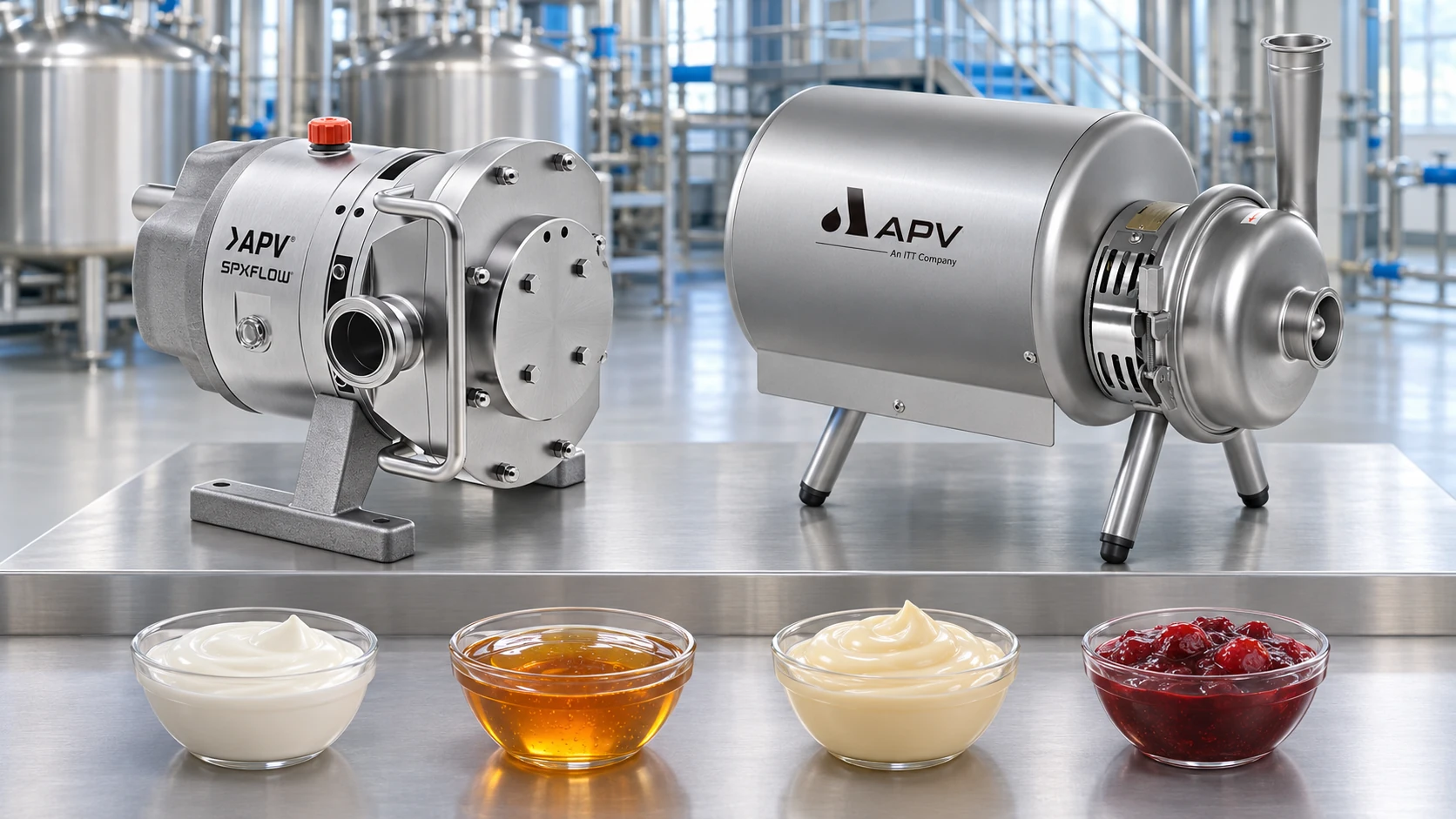
Selecting a pump for cream, syrups or cream fillings starts with the product’s properties and the operating conditions of the line. Centrifugal pumps are worth considering for free-flowing products when they can deliver the required flow rate and head at acceptable efficiency. Rotary positive displacement pumps are often suitable for thicker products and applications where preserving product structure is essential.
However, there is no universal viscosity threshold above which a rotary pump becomes mandatory. Temperature, differential pressure, rotational speed and the conditions at the pump inlet also influence the choice.
The APV SPX FLOW pump range includes both pumping principles. Choosing between them requires an assessment of the entire product route, from the supply tank outlet to the next process unit.
How Centrifugal and Rotary Pumps Differ
A centrifugal pump transfers energy to the product through an impeller. Its actual flow rate depends on the interaction between the pump performance curve and the system resistance. Changes in valve position, viscosity or heat exchanger resistance therefore shift the operating point.
A rotary positive displacement pump transfers volumes of product from the inlet to the outlet. Its flow rate depends mainly on displacement per revolution and rotational speed, but also on internal leakage through clearances and how completely the pumping chambers fill. Constant speed does not guarantee an absolutely constant flow rate.
Within the APV hygienic pump range:
W+ is a centrifugal series considered for applications including dairy products and syrups under suitable operating conditions.
V² is a centrifugal series for low- to medium-viscosity liquids.
DW+ comprises rotary positive displacement pumps for viscous and shear-sensitive products, with piston or bi-lobe rotor options.
The series identifies a starting point for selection. The specific pump configuration is chosen after the application has been calculated.
Viscosity: At What Temperature and Under Which Test Conditions?
A specification stating “viscosity: 3,000 mPa·s” is incomplete. The measurement temperature, test method and, for non-Newtonian products, shear rate must also be known.
Dynamic viscosity is commonly expressed in mPa·s or cP: 1 mPa·s = 1 cP. Kinematic viscosity, expressed in cSt, is a different quantity; conversion requires the product density.
For syrup, concentration and temperature are important. For cream fillings, the way the structure responds to mechanical stress also matters. A product may be thick at rest and become substantially more fluid during pumping. Non-Newtonian products therefore require an apparent viscosity at defined conditions or, where necessary, a rheological flow curve.
At least two operating conditions should be checked:
Normal operation: the product has reached its processing temperature and the line is running steadily.
Start-up: the product has cooled during a shutdown or has the highest viscosity expected within the formulation range.
A pump that transfers warm syrup successfully may not deliver the same flow during a cold start.
Increasing viscosity generally reduces the flow rate, head and efficiency of a centrifugal pump compared with its performance on water. A catalogue water curve therefore cannot be applied directly to a thick product: viscosity corrections or confirmation from the manufacturer are required.
Flow Rate and Differential Pressure: What Must the Pump Deliver?
The process determines the required flow rate. For example, transferring 2 m³ of product in 20 minutes requires an average flow of 6 m³/h. If that period includes valve switching or other operations during which no transfer takes place, the required instantaneous flow rate will be higher.
The required differential pressure is calculated by accounting for:
losses in pipes, bends, valves and filters;
resistance through the heat exchanger, mixer or dosing unit;
elevation differences;
pressure in the supply tank and receiving equipment.
For a thick product, pipe diameter can influence the result as much as pump selection. Installing a more powerful motor does not eliminate excessive resistance in an undersized line.
Head in metres and differential pressure in bar are related through product density. The maximum allowable casing pressure must also be distinguished from the differential pressure the pump can generate at the specified operating point.
A rotary positive displacement pump requires overpressure protection. Closing the discharge valve is not a way to regulate its flow: the pump continues displacing product, causing pressure to rise rapidly. The protective device and control interlocks must be defined during system design.
Shear: Will the Product Retain Its Structure?
For cream, emulsions and fruit fillings, the volume transferred is only part of the requirement. The product must also retain its intended consistency and processing characteristics after passing through the pump.
Shear occurs when adjacent layers of product move at different velocities. Its effect depends on pump design, rotational speed, clearances, differential pressure and the number of repeated passes.
A rotary positive displacement pump is often selected for gentle food product handling. The DW+ series offers rotor options for sensitive products and products containing inclusions. However, suitability for a particular formulation must be assessed separately.
When product structure is critical, acceptance criteria should include measurements before and after pumping: viscosity measured using the same method, the density of an aerated product, emulsion condition or particle integrity. Using a rotary pump does not replace product quality testing.
Engineering Selection Criteria
| Criterion | APV W+ / V² centrifugal pumps | APV DW+ rotary positive displacement pump | What to verify |
|---|---|---|---|
| Viscosity | Suitable when the corrected performance curve meets the required duty | Suitable for thick products when the pumping chambers fill adequately | Viscosity at operating and minimum temperatures |
| Flow rate | Depends on the pump curve and system resistance | Mainly determined by speed, with allowances for internal leakage and chamber filling | Minimum, nominal and maximum flow |
| Differential pressure | Check available head at the operating point | Check allowable differential pressure, torque and drive requirements | Resistance of the complete line and start-up conditions |
| Shear sensitivity | Assess the effect of the impeller and operating conditions on the product | Often a better candidate for gentle transfer | Product quality after pumping |
| Solid inclusions | Passage depends on pump design and particle size | Select rotors and internal passages to suit the inclusions | Size, hardness, concentration and acceptable damage |
| Suction conditions | Check the available NPSH | Also check chamber filling at the selected speed | Minimum tank level, tank pressure and inlet losses |
| Flow control | Variable-speed control with checks across the operating range | Usually speed control; feedback is needed where precise flow is required | Flow stability and allowable speeds |
| Blocked discharge | Check restrictions on operation at low or zero flow | Overpressure protection is required | Valve logic, sensors and interlocks |
This table helps identify the appropriate pumping principle. It does not replace verification of the performance of a specific pump size.
Need to determine which pump suits your formulation? Send your product data and line layout to Viravix. Our engineers can help assess the operating duty and installation requirements.
Cavitation and Suction Limitations
Cavitation occurs when local absolute pressure falls to the product’s vapour pressure. Vapour bubbles form and then collapse as they enter a higher-pressure region. This can cause noise, vibration, reduced flow and damage to pump components.
The assessment uses:
NPSHa — Net Positive Suction Head available: the suction head available from the system above the product’s vapour pressure.
NPSHr — Net Positive Suction Head required: the suction head required by the pump under specified operating conditions.
The available NPSH must exceed the required value by a margin appropriate to the application. The NPSH3 value shown on many centrifugal pump curves already corresponds to a 3% reduction in head. Matching NPSHa to NPSH3 therefore does not mean cavitation-free operation.
Viscous products introduce another limitation: the product may not enter a rotary pump quickly enough to fill its pumping chambers. This must be distinguished from vapour cavitation and air ingress.
Increasing speed under these conditions does not necessarily increase flow. APV DW+ performance data show that NPSH requirements depend on speed and viscosity, so they must be checked for the actual duty.
Practical measures for difficult inlet conditions include:
locating the pump closer to the tank and, where possible, below the product level;
shortening the suction line and calculating an adequate pipe diameter;
reducing restrictions, bends and fittings;
checking operation at the minimum tank level;
reducing speed while considering a pump with a larger displacement.
Temperature must also be assessed as part of the overall system. Heating can reduce viscosity but simultaneously increase vapour pressure. A warmer product therefore does not always provide a greater cavitation margin.
APV Pump Selection Examples for Food Products
The following are illustrative engineering scenarios. The flow rates explain the selection process, and the pump series are candidates for further calculation rather than confirmed selections.
Cream: Transfer to the Next Processing Stage
Duty: transfer 8 m³/h of cream from a buffer tank.
If the product is sufficiently fluid at the operating temperature, has a flooded suction and does not undergo unacceptable structural changes, an APV W+ or V² centrifugal pump is worth evaluating.
If the line must also handle colder or thicker cream, or if product structure requirements are more demanding, compare the centrifugal option with a DW+.
Decisive data: fat content, temperature, actual viscosity, number of passes through the pump and acceptable product changes. The word “cream” alone does not determine the pump type.
Syrup: Normal Operation and Restart After Cooling
Duty: feed 5 m³/h of syrup from a preparation tank to a blending unit.
A W+ may be a candidate for warm, free-flowing syrup. For a thick concentrate or a wide viscosity range, a DW+ should be evaluated.
Restart after a shutdown requires a separate calculation. If the syrup has cooled inside the pipework, pressure losses and drive loads increase. Heating should only be considered within the formulation’s permitted temperature range.
Decisive data: solids concentration, the relationship between viscosity and temperature, line length and cold-start conditions.
Cream Filling: Supply to a Depositor
Duty: transfer 1.5 m³/h of filling while preserving its consistency.
An APV DW+ is an initial candidate. The selection should assess whether the required flow can be achieved at a relatively low speed while maintaining an adequate product supply to the inlet.
If the depositor periodically stops the flow, its operation must be coordinated with the pump. Extended recirculation can change the filling’s temperature and structure, so it should not automatically be adopted as the main control method.
Decisive data: rheology, air content, allowable shear, depositor operating cycle and the filling’s behaviour after a shutdown.
Fruit Filling with Pieces
Duty: transfer 2 m³/h of product while preserving the inclusions.
A DW+ with suitable rotors can be considered, but selection begins with particle size, hardness and concentration. The connection diameter is not the same as the maximum allowable particle size.
Valves, bends and the dosing unit must also be checked: particles can be damaged elsewhere in the line.
Decisive data: the largest inclusion, its deformability and the acceptable proportion of damaged pieces.
What Information Is Needed to Select an APV Hygienic Pump?
To select a pump for viscous food products, prepare:
Product name, composition and formulation range.
Density and viscosity, including measurement temperature and test conditions.
Minimum, normal and maximum temperatures.
Required flow rate and operating mode — continuous or intermittent.
A piping layout showing lengths, diameters, elevations and process equipment.
Tank pressures and the minimum product level upstream of the pump.
Details of inclusions, air content and sensitivity to shear.
Cleaning conditions and requirements for seals and product-contact materials.
The selection should specify the operating point, rotational speed, drive power, inlet assessment and required protective measures. For sensitive formulations, it should also include criteria for checking product quality after transfer.
Viravix can help select APV pumps based on your product, pipework and process requirements. Send your application data to determine the appropriate series, configuration and operating conditions.