


14.10.2026
Breweries
How
Study
Beer Pasteurizer: What to Check Before Buying – Capacity, PU, Filling Line Stops and Energy Consumption
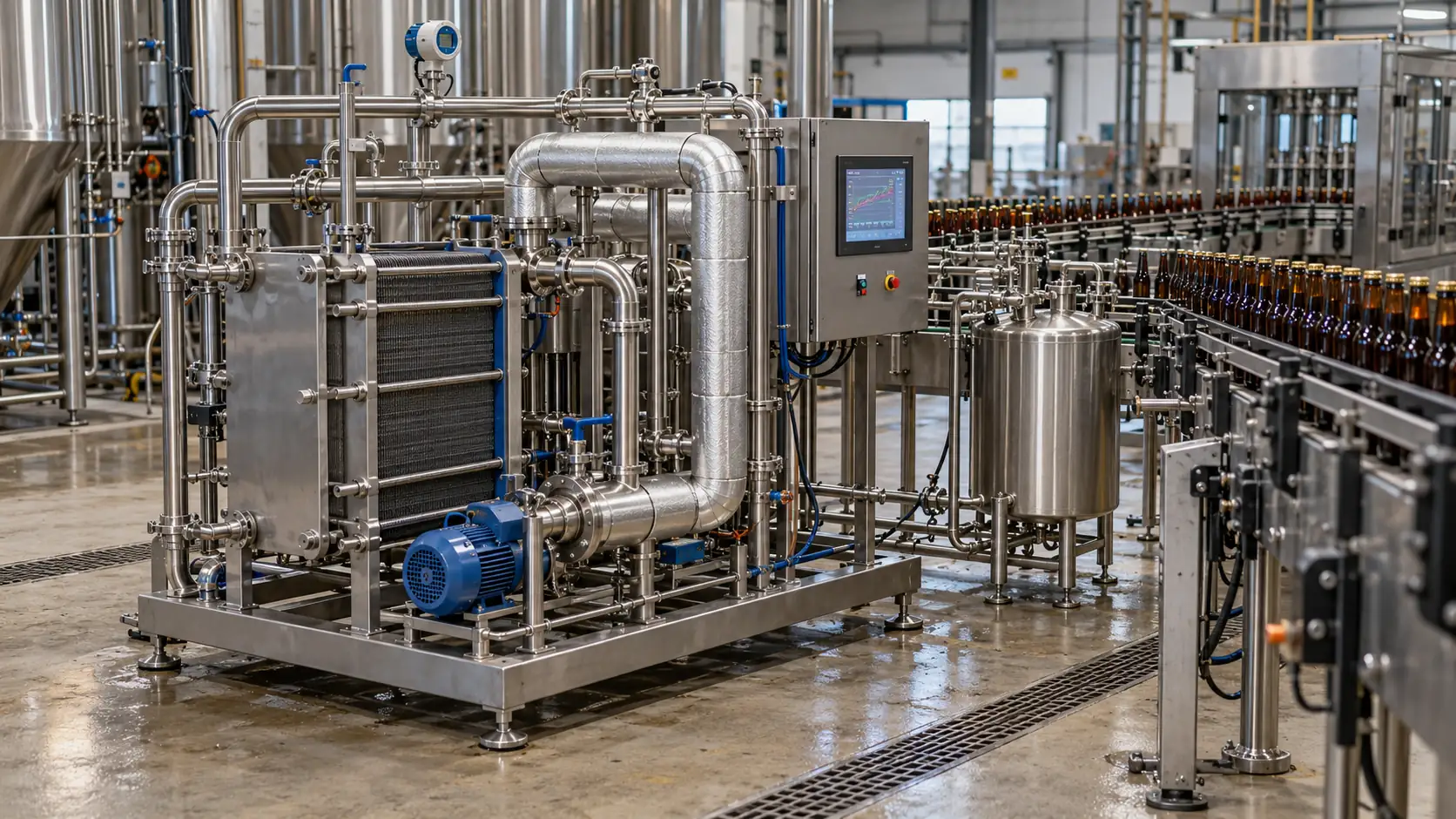
A beer pasteurizer should be selected together with the filling line, cooling system and cleaning programme. Two systems with the same rated capacity can differ significantly in utility consumption, product losses and their response to production stops.
Below are criteria for comparing proposals and calculation examples for preparing a technical specification. The figures illustrate the calculation methods and do not define a treatment process for any particular beer.
Flash or Tunnel Pasteurizer: Where to Start
The first question is where the product needs to be treated: before filling or after the containers have been filled and sealed.
| Criterion | Flash pasteurizer | Tunnel pasteurizer |
|---|---|---|
| Position in the process | Before filling | After filling and sealing |
| What is treated | Beer flowing through the system | Product inside sealed containers |
| Main selection parameters | Flow rate, temperature, holding time, pressure and heat recovery | Containers per hour, container format, temperature profile and accumulated PU |
| Essential requirement | Hygienic conditions throughout the downstream product path, including the filler | Containers and closures suitable for heating, cooling and internal pressure |
| Response to stops | Coordination with the buffer tank, flow control and a controlled transition to standby | Control of temperature zones to limit insufficient or excessive treatment |
| What to check separately | Minimum stable flow rate, pressure control and product losses during transitions | Performance with different container formats, treatment uniformity and response to conveyor stops |
Flash pasteurization does not compensate for recontamination after the heat exchanger. Selection must therefore include an assessment of the buffer tank, piping, valves, filler and their cleaning and disinfection procedures.
For a tunnel pasteurizer, knowing the spray-water temperature in each zone is not enough. The temperature profile of the product inside the container must be verified.
1. Capacity: Base the Calculation on Filling Line Operation
Pasteurizer capacity must match the actual demand of the filling line. Average output per shift and maximum instantaneous flow are different figures.
Example: A Line Producing 20,000 Bottles per Hour
For a 0.5-litre bottle, the nominal product demand is:
20,000 × 0.5 = 10,000 L/h.
Suppose the production target is 48,000 litres per eight-hour shift, with two hours allocated to preparation, changeovers, cleaning and downtime.
The required average output during the six production hours is:
48,000 ÷ 6 = 8,000 L/h.
However, selecting a pasteurizer rated at only 8,000 L/h would be a mistake: when the filler operates at full speed, it requires 10,000 L/h.
The technical specification should state:
- Maximum flow rate during steady filling.
- Minimum operating flow rate.
- Required output per shift.
- Duration and frequency of stops.
- Container formats and filling speed for each format.
Question for the supplier: Across what capacity range can the system maintain the agreed pasteurization conditions, outlet temperature and stable pressure?
2. PU: Why Temperature Alone Is Not Enough
Pasteurization units, or PU, describe the combined effect of temperature and time. In the commonly used brewing model, 1 PU is equivalent to one minute of treatment at 60 °C.
For a constant temperature, the following formula is used:
PU = t × 1.393^(T − 60)
Where:
- t is the time in minutes.
- T is the product temperature in °C.
How the Calculated Result Changes at the Same Holding Time
| Product temperature | Holding time | Calculated PU |
|---|---|---|
| 70 °C | 30 s | 13.8 |
| 71 °C | 30 s | 19.2 |
| 72 °C | 30 s | 26.7 |
In this example, increasing the temperature by just 2 °C almost doubles the calculated PU.
When the temperature varies, the contribution of each time interval is added together. The maximum temperature displayed on the operator screen therefore does not show the total treatment the product has received.
The same PU target should not be assigned to the entire product range. Targets must be justified by the relevant microorganisms, initial contamination, beer characteristics and storage requirements. Alcohol-free beer, beer-based drinks with added ingredients and conventional alcoholic beer require separate assessment.
Ask the supplier:
- Which formula and parameters does the control system use?
- Where is product temperature measured?
- How is holding time determined?
- What happens to PU when the flow rate changes?
- How does the system respond to deviations?
- Which data are stored for batch verification?
3. Filling Line Stops: Check the Control Sequence Before Ordering
A pasteurizer may perform consistently at its rated capacity but generate product losses during frequent short filler stops.
For a flash pasteurizer, the relationship between flow rate and residence time in the holding tube is particularly important.
If the flow through an unchanged holding tube is halved, the calculated average residence time doubles. At an unchanged temperature, the calculated thermal load also increases.
However, the average residence time obtained by dividing volume by flow rate does not replace verification of the minimum holding time, taking flow behaviour into account.
Use specific operating scenarios to compare proposals:
| Situation | What to check |
|---|---|
| The filler runs at half speed | How flow rate, temperature and holding time change |
| The filler stops completely | Where the product goes and how long the system can continue operating |
| The buffer reaches its upper level | The sequence for switching to standby |
| Product temperature falls below the agreed limit | How insufficiently treated product is prevented from reaching the filler |
| Production resumes after an extended stop | The conditions required to return to production |
| An emergency power failure occurs | How the status of the product inside the system is determined |
These scenarios should be included in the acceptance test programme.
Example: How Much Operating Time Does a Buffer Provide?
Suppose the pasteurizer operates at 10,000 L/h and the filler stops for eight minutes.
During this period, the volume entering the buffer is:
10,000 × 8 ÷ 60 = 1,333 litres.
To continue operating at an unchanged flow rate, at least 1,333 litres of available working capacity are required.
If 1,500 litres are available when the stop occurs, the calculated buffer time is:
1,500 ÷ 10,000 × 60 = 9 minutes.
This does not mean that a tank with a geometric volume of 1.5 m³ is sufficient. The initial fill level, operating limits, gas headspace and control system response time must also be considered.
4. Pressure and CO₂: Check the Entire Product Path
For carbonated beer, specifying the inlet operating pressure alone is not enough.
During heating and passage through the equipment, conditions must prevent CO₂ from coming out of solution. The required pressure depends on temperature, CO₂ content and pressure losses.
The technical specification should define:
- The CO₂ content range.
- Beer inlet temperature and pressure.
- Pressure requirements upstream of the filler.
- Pressure losses across the heat exchanger, holding tube, valves and piping.
- Control performance at minimum and maximum flow rates.
- Control of the pressure differential between the pasteurized and unpasteurized sides of the regeneration section.
The permissible increase in dissolved oxygen across the system should also be agreed separately. Pasteurization does not eliminate the effects of oxygen pickup.
5. Heat Recovery: Compare Performance Under the Same Conditions
A heat recovery percentage is meaningful only when accompanied by inlet and outlet temperatures, flow rate and measurement conditions.
Example: 90% Versus 95% Heat Recovery
For a simplified calculation, assume:
- Capacity – 10,000 L/h.
- Beer density – 1 kg/L.
- Specific heat capacity – 4.0 kJ/(kg·°C).
- Heating – from 4 to 72 °C.
- Steady operation without heat losses.
Without heat recovery, the required heating power is:
P = (10,000 ÷ 3,600) × 4.0 × (72 − 4) ≈ 756 kW.
| Parameter | 90% heat recovery | 95% heat recovery |
|---|---|---|
| Calculated external heating power | 75.6 kW | 37.8 kW |
| Energy for external heating over eight hours | 604.8 kWh | 302.4 kWh |
In this example, increasing heat recovery by five percentage points halves the external heating requirement.
Over 2,000 operating hours under these conditions, the difference is approximately:
37.8 × 2,000 = 75,600 kWh of thermal energy.
This is not the system’s total energy consumption. The actual balance must also include start-ups, stops, heat losses, cleaning, pumping and cooling.
Check whether higher heat recovery comes with excessive pressure losses or increased equipment cost. The final choice should consider the total cost over the equipment’s operating life.
6. CIP and Product Losses: What Is Often Missing from the Proposal
Assessing a pasteurizer solely by its steam consumption during steady operation is not enough.
For short production runs, preparation, product-to-water transitions and cleaning can account for a substantial share of operating costs.
Ask the supplier to specify:
- The internal volume of the product circuit.
- Expected product losses during start-up and shutdown.
- How the interface between beer and water is detected.
- The flow rate, temperature and pressure required for CIP.
- Cleaning coverage for the buffer tank, holding tube, valves and piping up to the filler.
- The conditions for releasing the system to production after cleaning.
- The parameters used to confirm completion of the cleaning programme.
Useful comparison figures include thermal energy, electricity, water, cooling demand and beer losses per 1,000 litres of saleable product. The calculation conditions must be the same for every proposal.
What to Include in the Technical Specification
| Section | Required information |
|---|---|
| Product | Product range, alcohol content, pH, CO₂, yeast and particles, inlet and outlet temperatures |
| Treatment conditions | Justified PU targets, permitted limits and the method for verifying treatment |
| Filling | Container types and formats, maximum and minimum throughput, stop frequency |
| Buffer | Working levels, required buffer time, pressure and hygiene requirements |
| Utilities | Available steam or hot water, coolant, water, compressed air and electrical supply |
| CIP | Available cleaning programmes, flow rate, temperature, chemicals and cleaning circuit boundaries |
| Automation | Signal exchange with the filler, interlocks, emergency sequences and data archiving |
| Acceptance | Tests at maximum and minimum flow, stops, restarts, utility consumption and product losses |
Verify Performance Against Your Operating Scenarios
Before accepting the pasteurizer, verify its performance with the agreed products and operating conditions. Pay particular attention to minimum capacity, filler stops, production restarts and transitions between beer and water.
The records should make it possible to reconstruct the treatment of each batch: temperature, flow rate, calculated PU, critical pressures, valve positions, alarms and operator actions. Automation data complement microbiological and sensory verification of the result.
Viravix Engineering helps select and integrate beer pasteurizers or upgrade existing systems. Send us your product parameters, filling schedule, stop history and available utilities – we will use this information to develop a technical solution for your production requirements.