


13.11.2026
How
Study
Juice Pasteurizer: Design Considerations for Juices, Nectars and Beverages with Pulp
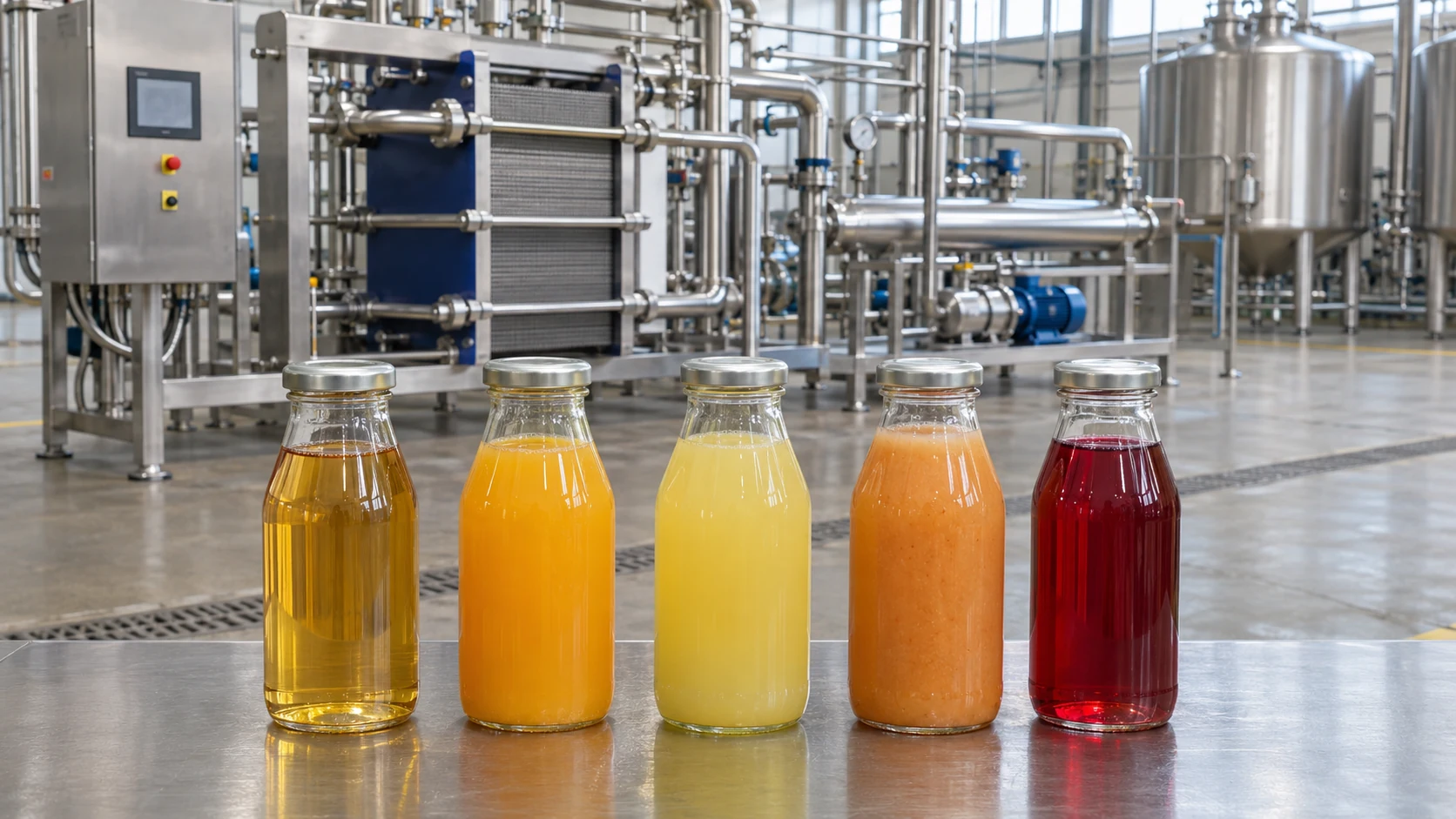
A juice pasteurizer is selected based on product properties, the required heat treatment and filling conditions. Capacity in litres per hour is only one of the starting parameters. Viscosity, acidity, pulp content and particle size determine the heat exchanger design, pressure drop and holding requirements.
A system designed for clarified apple juice will not necessarily deliver the same capacity when processing thick peach nectar. Likewise, a stable outlet temperature alone does not confirm adequate treatment of a beverage containing fruit pieces.
For predictable performance, heating, holding, cooling and delivery to the filler must be designed as one integrated process.
Which Product Characteristics Are Needed for System Design?
The technical specification should include data for every product intended to run through the system.
| Parameter | What it affects |
|---|---|
| pH and its permitted variation | Selection and validation of the heat treatment |
| Soluble solids content, °Brix | Assessment of density, specific heat capacity and formulation properties |
| Viscosity at different temperatures | Heat transfer, pressure drop, pump selection and heat exchanger channel design |
| Pulp content, fibre length and maximum particle size | Product passage through equipment, blockage risk and structural integrity |
| Density and specific heat capacity | Conversion of volumetric flow to mass flow and calculation of heating duty |
| Product inlet temperature | Heating section duty |
| Filling method and filling temperature | Cooling configuration and heat recovery potential |
| Required shelf life and storage temperature | Requirements for the entire process, including packaging |
| Previous treatment and microbiological characteristics of the raw material | Definition of the required pasteurization effect |
°Brix does not replace viscosity measurements. Two beverages with the same °Brix value can behave differently in processing equipment because of pectin, pulp or stabilizers. For viscous products, measurement conditions also matter: temperature and shear rate affect the result.
When several formulations are involved, the system should be checked against the limiting conditions: the lowest inlet temperature, highest viscosity, maximum particle content and highest flow rate. These conditions may belong to different products.
Comparing Requirements for Different Beverage Types
The following table provides an initial guide to system design. Final equipment selection requires thermal and hydraulic calculations.
| Product type | Characteristics | Heat exchanger options to consider | Key checks |
|---|---|---|---|
| Clarified apple or grape juice | Usually low viscosity with minimal suspended particles | Plate | Heating duty, heat recovery and allowable pressure drop |
| Cloudy juice with fine pulp | Suspended particles, possible fibres and settling | Plate with suitable channel geometry, or tubular | Product passage, flow distribution and pulp accumulation |
| Citrus juice with fibres and juice sacs | Fibrous structure; inclusions sensitive to mechanical stress | Tubular; plate only after confirming suitability | Passage of fibres through all components and preservation of inclusions |
| Peach, apricot or mango nectar | Purée content; elevated, temperature-dependent viscosity | Tubular; scraped-surface for particularly viscous formulations | Heat transfer, pump duty and fouling |
| Juice-based beverage without pulp | Properties depend on sugar, acids and stabilizers | Often plate | Formulation stability during heating and foaming |
| Beverage with fruit pieces or aloe vera | Separate liquid phase and large inclusions | Tubular, designed for the specified particles | Heating of particle centres, particle residence time and passage through valves and pumps |
For beverages with large inclusions, the liquid phase may be hotter than the centre of a particle. The treatment must therefore be validated with particle heating in mind, rather than relying solely on a temperature sensor in the flowing liquid.
How to Select a Heat Exchanger for Juice Pasteurization
Plate Heat Exchangers: For Products That Flow Freely Through the Channels
A plate heat exchanger offers efficient heat transfer, compact construction and effective heat recovery. It is a suitable option to consider for low-viscosity juices and beverages with limited inclusions.
The limitation is not simply whether pulp is present. Pulp characteristics and channel geometry are what matter. Fibres can become trapped in narrow passages and at plate contact points. Maximum particle size, concentration and fibre length must therefore be checked.
Tubular Heat Exchangers: For a Broader Range of Formulations
Tubular heat exchangers are frequently used for juices containing fibres, nectars and beverages with particles. Their geometry can be adapted to the product, but a wide passage alone does not guarantee adequate heat transfer.
Tube diameter, flow velocity, heat transfer area and pressure drop must be considered together. The choice between plate and tubular designs depends on beverage properties and the specified operating conditions.
Scraped-Surface Heat Exchangers: For Challenging, Highly Viscous Products
In a scraped-surface heat exchanger, moving elements remove deposits from the heat transfer surface and mix the product near the wall. This design is considered when high viscosity or severe fouling limits the performance of other heat exchanger types.
It requires a separate engineering assessment, including mechanical effects on the product, maintenance of moving components and operating costs. This design is generally unnecessary for a conventional low-viscosity juice.
Heating: Achieving the Required Treatment Without Overprocessing
There is no universal pasteurization schedule for all juices and nectars. Temperature and treatment time are determined for the specific formulation, target microorganisms, raw material characteristics and subsequent storage conditions. Heating alone does not demonstrate that the required microbiological effect has been achieved.
Enzymes must also be considered. For example, primary processing of orange juice requires attention to pectin methylesterase inactivation because this enzyme affects cloud stability. The objectives of primary processing and subsequent pasteurization before packaging may differ.
A controlled hot-water circuit is often used for indirect juice heating. It allows the temperature difference between the heating medium and the product to be controlled. An excessively hot surface increases the risk of local overheating and deposit formation.
The design must balance these factors: a smaller temperature difference generally requires a larger heat transfer area. Product quality, equipment cost and operating time between cleaning cycles should therefore be assessed together.
Holding: Why Calculating Tube Volume Is Not Enough
A preliminary holding section volume can be calculated using:
V = qᵥ × τ
where:
V is the holding section volume, L;
qᵥ is the volumetric flow rate at holding temperature, L/s;
τ is the time, s.
For example, at a flow rate of 5,000 L/h and an illustrative holding time of 30 s:
V = (5,000 ÷ 3,600) × 30 ≈ 41.7 L.
This is the volume corresponding to the calculated mean residence time, not confirmation of the minimum holding time for all the product.
An actual flow has a velocity distribution influenced by viscosity, flow regime and holding section geometry. For products containing inclusions, particle velocity and the time needed to heat the particle centre must also be considered. The minimum residence time must be validated for the specific product and operating flow range.
Increasing pump capacity without checking the holding section can therefore compromise the established treatment.
Example: Calculating a Juice Pasteurizer’s Heating Duty
Consider a hypothetical juice with the following design inputs:
| Parameter | Assumed value |
|---|---|
| Inlet capacity | 5,000 L/h |
| Density at inlet temperature | 1,045 kg/m³ |
| Mean specific heat capacity | 3.9 kJ/(kg·K) |
| Inlet temperature | 20 °C |
| Heating temperature | 95 °C |
The temperature of 95 °C is used only to illustrate the thermal calculation. It is not a recommended treatment temperature for a specific juice. Density and specific heat capacity must be confirmed for the formulation used in the actual project.
Mass flow rate:
ṁ = 5 × 1,045 ÷ 3,600 ≈ 1.45 kg/s.
Heating duty without heat recovery:
Q̇ = ṁ × cₚ × (T₂ − T₁)
Q̇ = 1.45 × 3.9 × (95 − 20) ≈ 425 kW.
The stream therefore requires approximately 425 kW of heating duty, excluding heat losses.
What Changes When Heat Is Recovered?
Assume that, during steady operation, the regeneration section provides 80% of the required temperature rise:
Temperature after regeneration = 20 + 0.80 × (95 − 20) = 80 °C.
The external heating medium then only needs to raise the product temperature from 80 to 95 °C:
Final heating duty = 1.45 × 3.9 × (95 − 80) ≈ 85 kW.
Under these assumptions:
approximately 340 kW is recovered through regeneration;
approximately 85 kW must be supplied externally.
This is the heat balance for a hypothetical system, not a guaranteed saving for every pasteurizer. The actual level of heat recovery depends on filling temperature, heat exchanger configuration and product properties.
The heat source cannot be sized solely on the 85 kW figure. At start-up, there is no outgoing hot product available for heat recovery. Start-up demand must be covered by the available heating capacity or by a defined warm-up procedure and flow limitation.
Heat transfer area, pressure drop and performance at the end of the production run must be calculated separately, allowing for deposits that may have accumulated on the surface.
Cooling Must Match the Filling Method
The required pasteurizer outlet temperature is determined by the next processing step.
For hot filling, the product must reach the filler at the specified temperature. Extensive heat recovery is limited because a substantial amount of heat must remain in the product until the container is filled.
For cold filling with refrigerated storage, adequate cooling capacity, temperature control and appropriate hygienic protection after pasteurization are required.
For aseptic filling, the delivery temperature must meet the filler’s requirements, and the entire downstream product path must maintain the required aseptic conditions.
A long shelf life for an acidic juice does not automatically require UHT treatment. Low-acid beverages present substantially different heat treatment requirements; process selection depends on formulation, microbiological risks and packaging method.
The VIRAVIX industrial pasteurizer range includes different equipment configurations. For suitable short-time pasteurization processes, an HTST pasteurizer for milk and beverages can be considered. Where the process requires ultra-high-temperature treatment, a UHT system for juices, dairy products and beverages should be evaluated.
Fouling: Accounting for Performance Changes During a Production Run
Deposits add resistance to heat transfer. A system that meets the required conditions immediately after cleaning may gradually lose capacity or require a higher heating-medium temperature.
The pasteurizer should therefore be designed not only for clean surfaces, but also for the agreed production run length.
Design checks should cover:
heat transfer surface temperature and the risk of local overheating;
product velocity and potential areas of pulp accumulation;
allowable pressure drop;
the ability to clean all channels and the holding section;
access for inspection and maintenance.
To monitor equipment condition, pressure drop and temperatures should be compared at the same flow rate and with the same formulation. Increasing resistance or a need for a hotter heating medium may indicate fouling. Without accounting for product properties, these indicators can be misinterpreted. Fouling and flow conditions must be included in the thermal assessment.
What Should Happen When Filling Stops?
A filler stoppage changes the pasteurizer’s operating conditions. Continuing to heat without discharging product increases its cumulative heat exposure. Arbitrarily reducing flow changes both the flow conditions and residence time.
The response to a stoppage must be defined during system design.
| Event | Required provision |
|---|---|
| Short filler stoppage | Product transfer to a suitable buffer tank or an agreed recirculation mode |
| Extended stoppage | Limits on repeated heating and a defined shutdown procedure |
| Temperature below the specified limit | Automatic diversion of product away from filling |
| Flow outside the validated range | Prevention of delivery to the filler or transition to a defined safe operating mode |
| Restart | Verification of stable process conditions before product is returned to the filler |
A buffer tank can reduce the number of times product passes through the heating section, but its design must meet the requirements of the process downstream of pasteurization.
The control system should record temperature, flow rate, diversion valve states and deviations. Where product-to-product regeneration is used, the design must also protect the treated stream against contamination through a leaking heat transfer surface, including appropriate pressure management and monitoring.
What Information Is Needed to Specify a Pasteurizer?
The following information is needed for an initial system assessment:
A list of juices, nectars and beverages, including formulation characteristics.
Minimum, nominal and maximum capacity.
Product temperatures at the inlet and before filling.
Pulp content, particle dimensions and requirements for preserving their structure.
A substantiated heat treatment schedule or the data needed to establish one.
Packaging method, shelf life and storage conditions.
Filler capacity, stoppage frequency and stoppage duration.
Available steam, hot-water, cooling and electrical supply conditions.
Required operating time between cleaning cycles and equipment layout constraints.
Need a Pasteurizer Designed for Your Product?
VIRAVIX designs pasteurization modules around product properties, available utilities and the requirements of the existing filling line.
Send us your beverage specifications, required capacity and packaging method. We will develop the heat exchanger, heating, holding and cooling configuration and define how the module will integrate into your production process.